Developers
blukii Hub Configuration Website
Access the Website
You can access the configuration website via https://*
Alternatively you have access it via hostname: https://hubabcd0123/ if this is supported by your network.
Finally it can be accessed via local IP address. Therefore, please see Hub Status on blukii Manager or ask your network administrator.
If the website can not be accessed, please check the network connection. restricted access could be a reason. Therefore, see section Initial blukii Hub Network Setup.
For some hardware variants Ethernet and LTE communication are supported. Please check your delivery information.
Information of current connection state is shown on Status Info.
Website structure
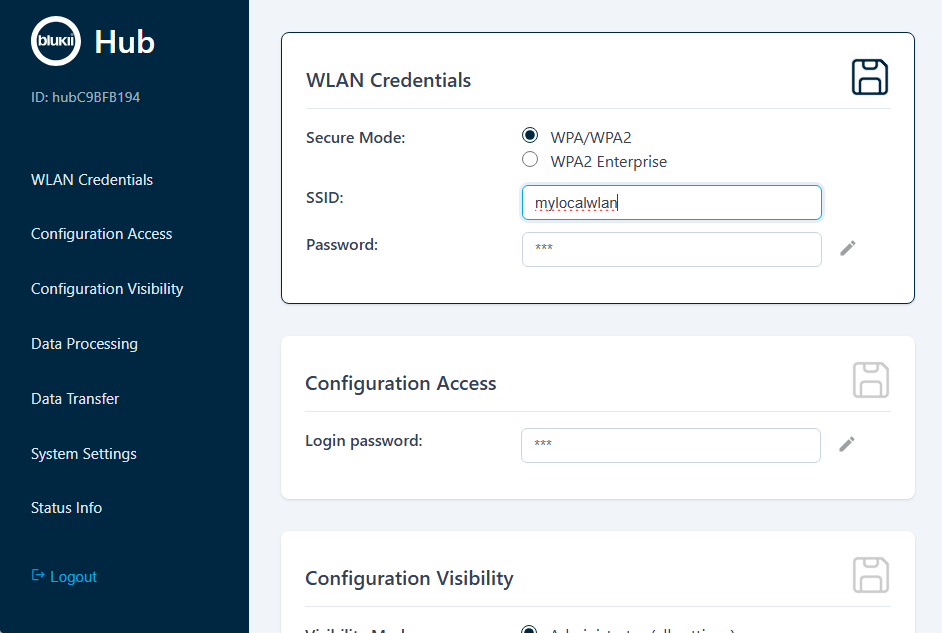
The menu contains the Hub ID on top, followed by navigation links that leads to all available sections.
The content area contains the available configuration sections.
Each section has to be separately saved after changing any settings. The section and its save button is highlighted if there some unsaved modifications.
The website has got a reponsive design for small browser views on mobile devices.
Login and user session
User Login
The configuration website is protected by a password based login. The password is defined by the Hub administrator at initial startup (see Initial blukii Hub Network Setup) and can be edited on section Configuration Access
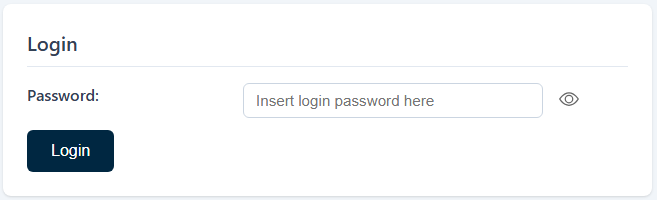
There is a session timeout. After 10 minutes without user action the user is automatically logged out.
Please use the logout link on websites navigation to finish your user session manually.
Administrator Login
If the configuration website is loaded as restricted user (see Visibility Mode), you can login as administrator in order to access all settings.
Clicking “Administrator login” on Status Info leads to Administrator login view.
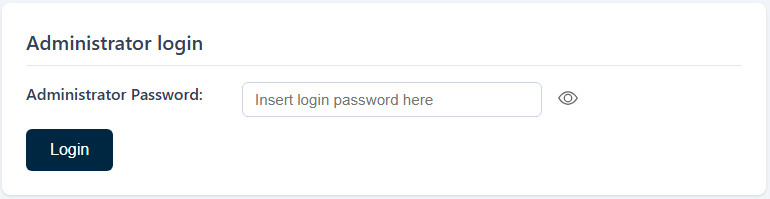
Note: calling the Hub URL with parameter /admin leads you directly to the Administrator login.
Configuration Sections
The Configuration view is separated in topic related sections. Each section must be saved separately after editing a value.
WLAN Credentials
Settings for connecting to a WLAN network.

-
Secure Mode
-
WPA/WPA2: Basic Authentication with SSID and Password
-
WPA2 Enterprise: Enterprise Authentication with SSID, Identity and Password
-
-
Note:
-
If the WLAN credentials are changed and there is no connection to Ethernet or LTE, the blukii Hub is restarted.
-
If SSID or Password are empty and Ethernet is not connected, the WLAN Access Point is activated. If LTE connection is configurated (see Data Transfer), the WLAN Access Point is activated for the first 5 minutes after blukii Hub restart.
-
Configuration Access
Settings for protecting the Access to this configuration website.

-
Login password: the password for website login. This must be at least 6 characters.
-
Access Mode (hidden): This selection is only visible for Hubs (updated from versions before 3.2.x), that still works without login password. For new produced hubs since version 3.2.x a login password is mandatory.
-
Free, no password: the configuration website is always accessible for everyone in the local network.
-
Password protected: the configuration website will be password protected. You have to set a login password.
-
Configuration Visibility
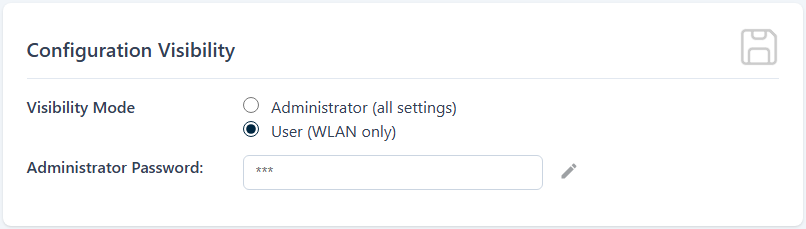
Settings for reducing the configuration sections for reduced user rights.
-
Administrator (all settings): all configuration settings are always visible. You are acting as administrator.
-
User (WLAN only): only the sections WLAN Credentials and Status Info are visible, all other sections are hidden. You are acting as user. You can login as administrator by clicking the link Administrator Login on section Status Info
-
User (WLAN only), administrator without login (hidden): This selection is only visible for Hubs (updated from versions before 3.2.x), that worked without password in the past. Only the sections WLAN Credentials and Status Info are visible, all other sections are hidden. You are acting as user. You can show all fields by calling the URL parameter /admin. No password is required.
Data Processing
Settings for scan and collection of blukii advertising data.

-
Data Types: Defines, which blukii data packet types are collected.
-
iBeacon: UUID, Major, Minor, Measured Power
-
Eddystone UID: Namespace, Instance
-
Eddystone TLM: Battery (in mV), Temperature, Packets, Active Time
-
Sensor Beacon: Accelerometer Axis Values
-
Device Tracing: RSSI-Distance to other blukii Device Tracing Beacons
-
Special Frame: Customer defined or future values
-
-
Collection Mode:
-
One Per Data Type: For each packet type and blukii Beacon will be collected only one (the last) packet during push interval.
-
All Packets: All packets are collected. Duplicates of packet type and blukii Beacon are allowed.
-
-
Push Interval: Time (in seconds) of one collection duration.
-
Life Monitoring: If option “Push even if no packets found” is checked, the blukii Hub pushes requests to server even if no frame data is available. This option is only available if at least one Data Type is selected.
Note:
-
It is recommended to reduce the processed and transferred data amount. Consider the Data Processing settings for optimizing your system:
-
Check only relevant data types.
-
Use Collection Mode “All Packets” only for high performance data logging like Accelerometer Sensor.
-
Use fast push interval (smaller than 5 seconds) only for high performance data logging or for high update rates.
-
The data packet amount per push interval is limited (depends on selected data types and amount of different blukii IDs) to approx. 75 data packets.
-
-
After every push interval duration a push request will be sent to the defined server url. If no data packet is found during the push interval, the request is skipped.
-
If request is done, the green LED will be paused until the request is finished.
-
blukii Hub does not support third party beacons (blukii Beacons only).
Data Transfer
Settings for connection to the target server for blukii packet data.

-
Server Url: Target server url for push requests
-
Push Medium
-
WLAN / Ethernet
-
LTE
-
-
Push Method
-
POST
-
PUT
-
-
Authentication
-
Off: No Authentication
-
Basic: Basic Authentication (Username, Password)
-
Bearer: Bearer Token Authentication (Token)
-
-
Api Key: Optional additional ApiKey Authentication (X-API-KEY)
-
Payload JSON Format: JSON Format in push request body
-
1.0 (default): Standard format with pre-parsed values
-
2.0 (optimized): Size optimized format with byte coding
-
Note:
-
If “WLAN / Ethernet” is selected as “Push Medium”, “Ethernet” is prioritized. WLAN is only active if Ethernet is not connected.
-
Section “Push Medium” is only shown if LTE is supported by the blukii Hub hardware.
-
“Push Method” is only shown if “WLAN / Ethernet” is selected as “Push Medium”. “PUT” is not supported for LTE communication.
-
The “Push Medium” is also used for requests to blukii Server (logs and updates). See section System Settings.
System Settings
Administrative settings for system logging and maintainance.

-
Hub description: Individual description for the Hub.
-
Log Level: Level of system logging messages
-
Severe
-
Warning (default)
-
Info
-
-
Log to file: Log Messages are stored in internal log file (default: off).
-
Log to blukii Manager: Log Messages are sent to blukii Manager (default: on).
-
Sync to blukii Manager: The Hub is periodically checking, if a configuration or firmware update is available (default: on).
Note:
-
Change Log Level and Log to file only in consultation with blukii support! This may affect the system performance.
-
If Log to file is enabled and a log file is existing. The following action icons are shown in order to download and clear the log file:

-
For Log To blukii Manager a internet connection to blukii Manager is needed. Only system processing data is logged, no passwords or api keys. It is recommended to switch this feature off, if the Hub is in a local network without external access.
-
Configuration Updates You can update the configuration on this local website or remotely on blukii Manager. If the configuration is modified on local website, the update is immediately synced to blukii Manager. Modifications on blukii Manager are synced by the Hub delayed. Therefore, the Hub checks each 5 minutes, if a remote update is available.
-
Firmware Updates can be triggered on blukii Manager by the Hub owner. During the update, red and green LED are blinking simultaneously.
Status Info
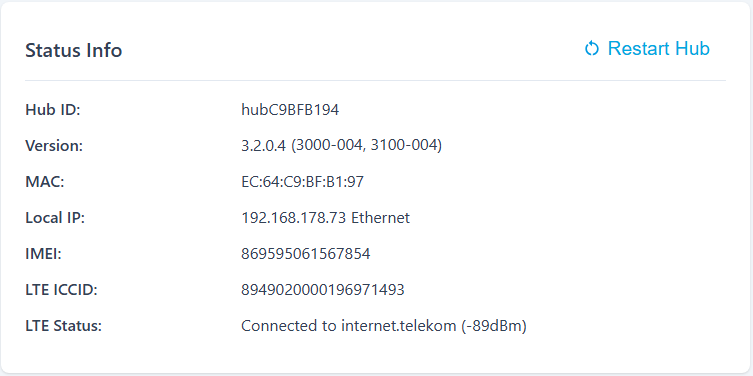
Hub status parameter and administrative actions.
-
Administrative actions
-
Administrator Login: This option is shown if logged in as restricted “User (WLAN only)”. This leads to the Administrator Login page.
-
Restart Hub: This option is shown if logged in as Administrator. Hub restart is initiated and the user is logged out.
-
-
Status Info
-
Version: Firmware version (hardware version and LTE hardware version, if supported)
-
MAC: WLAN / Ethernet MAC address
-
Local IP: IP address in local network, if Ethernet or WLAN is connected.
-
IMEI: IMEI number of LTE modem, if LTE is supported by hardware.
-
ICCID: ICCID of SIM card, if available.
-
LTE Status: LTE connection state, if LTE is supported:
-
Modem not available: LTE modem initializing error
-
Connecting to modem: LTE modem is initializing
-
no SIM: SIM card is missing
-
no LTE connection: no connection to internet
-
Connecting to APN: searching for internet connection
-
Connected to APN: connected to internet (signal strength in dBm)
-
-
GPS Position: Latitude and Longitude, if GPS signal is received. “View maps” link opens Google Maps position in new browser window.
-
GPS Details: More details, if GPS signal is received.
-